
Van Nuys Airport · VNY
Learning to Fly at Van Nuys Airport
Short answer: Van Nuys gives student pilots early experience with a control tower, parallel runways, radio communication and busy Los Angeles-area airspace. The FAA identifies VNY as Class D airspace beneath Burbank Class C. With a structured instructor-led progression, that complexity becomes practical training in communication, planning and situational awareness.
What makes VNY different
A real controlled-airport training environment
The FAA's Van Nuys “Know Before You Go” page identifies closely spaced parallel runways 16L/34R and 16R/34L, staggered thresholds and full-length parallel taxiways. It also notes that VNY's Class D airspace underlies Burbank Class C airspace. Those are not marketing claims; they are operational facts that pilots must understand before each flight.
- You learn to listen, plan a concise radio call and respond to tower instructions.
- You practice positive runway identification and hold-short discipline.
- You develop a mental picture of nearby traffic, airspace and the intended departure or arrival.
- You learn to slow the process down with a briefing and checklist when the environment feels busy.
The current airport diagram, chart, weather, NOTAMs and ATC instructions—not a website guide—govern each operation.
Transferable pilot skills
What students can learn from the environment
These skills support training beyond Van Nuys. The objective is not to make every lesson feel busy; it is to build calm, repeatable habits that work at both towered and nontowered airports.
A normal training block
How a lesson is structured
- Preflight briefing
Set one or two measurable objectives, review weather and airport information, and brief the taxi, runway and departure plan.
- Preflight and cockpit setup
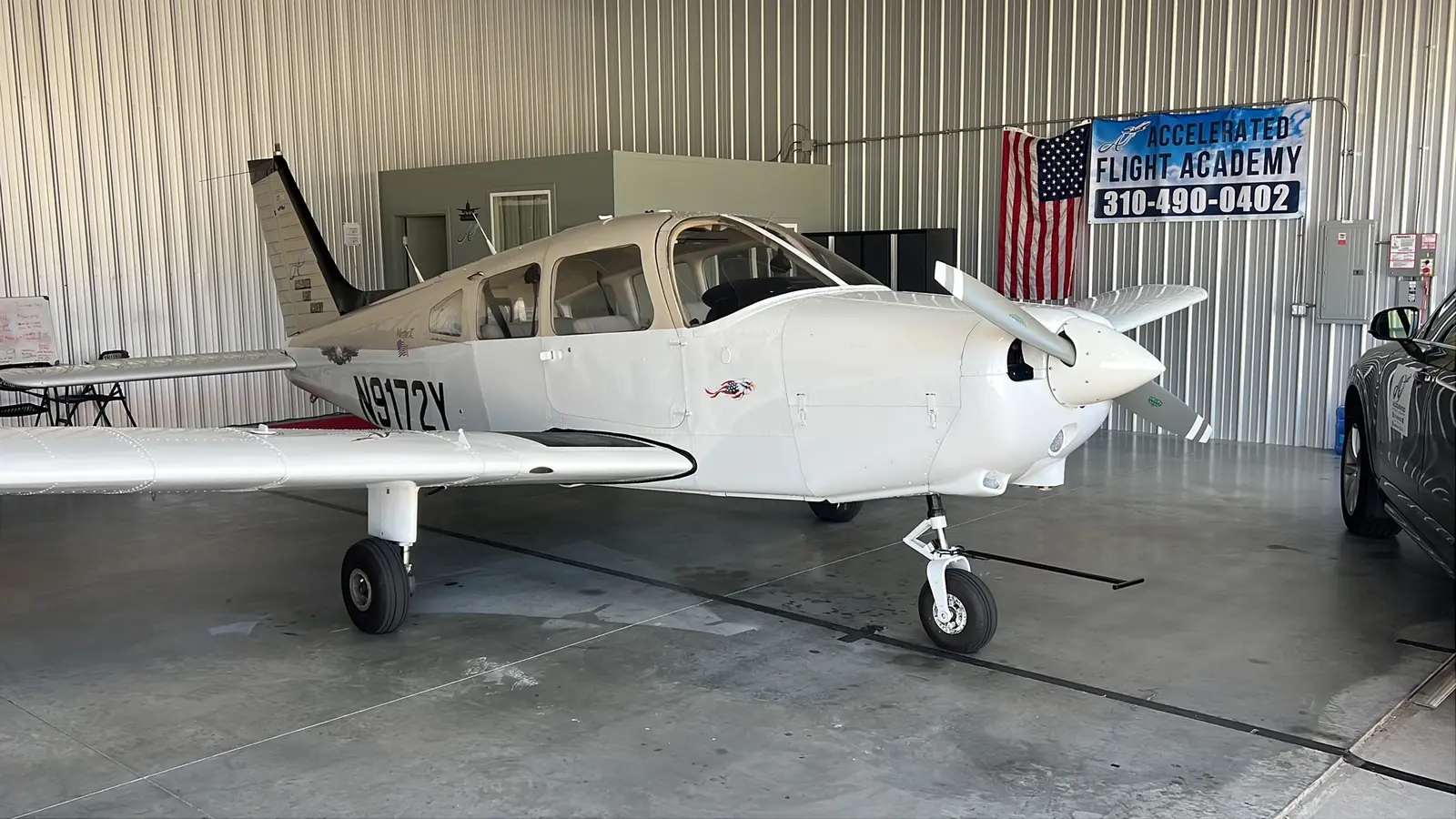
Inspect the Piper Warrior II, organize charts and frequencies, complete checklists and identify likely high-workload moments.
- Ground and tower operations
Practice clearances, taxi instructions, hold-short compliance and departure communication with instructor support appropriate to your experience.
- Flight lesson
Complete the planned maneuvers, navigation or instrument work in an area and sequence suitable for the day's conditions.
- Debrief and next action
Identify what met the standard, what needs improvement and what ground study will make the next flight more productive.
Choose with open eyes
The benefits and tradeoffs of learning at Van Nuys
| Potential advantage | Planning consideration |
|---|---|
| Frequent tower communication | New students need coaching and preparation so radio workload does not crowd out aircraft control. |
| Parallel-runway environment | Runway identification, taxi briefings and hold-short discipline must be deliberate on every lesson. |
| Los Angeles-area airspace | Routes and altitudes require current-chart review and good situational awareness. |
| Real traffic sequencing | Taxi or airborne delay can occur, so each lesson should have flexible objectives and a clear training-value plan. |
| Access to varied operations | Weather, traffic, runway use, maintenance and temporary restrictions change; no route or timeline should be promised. |
Before your first lesson
Arrive ready to learn—not already overwhelmed
- Confirm the meeting time and exact access instructions directly with Reza.
- Bring a government-issued photo ID and any pilot documents or logbook requested for your training stage.
- Wear comfortable clothing and closed-toe shoes; bring sunglasses and water.
- Share motion-sickness concerns, accessibility needs or medical questions before the flight.
- Expect weather, air traffic, maintenance or operational conditions to change the route or require rescheduling.
- For a first discovery lesson, review what to expect on a Los Angeles discovery flight.
Airport details and airspace services can change. Pilots and instructors must use current FAA publications, charts, weather, NOTAMs and ATC instructions for the actual flight.
Primary sources
Check the airport and airspace directly
- FAA: Van Nuys Airport Know Before You Go
- FAA Aeronautical Information Manual: Controlled Airspace
- FAA AIM: Airport Operations and Tower Communication
- Los Angeles World Airports: Van Nuys Airport description
- FAA: Current Chart Supplement and airport data search
This page explains the learning environment; it is not flight-planning information and does not replace current FAA publications, instructor briefings or ATC instructions.
Quick answers
Van Nuys flight-training questions
Is Van Nuys Airport too busy for a new student pilot?
No, but the environment requires structured instruction. A new student begins with briefed, instructor-managed radio calls, taxi routes and traffic awareness. Workload is increased gradually as skill and confidence improve.
What kind of airspace surrounds Van Nuys Airport?
The FAA identifies VNY as Class D airspace underlying Burbank Class C airspace. Current charts, notices and airport information must be reviewed for every flight because boundaries, services and operational details can change.
Will I learn radio communication from the first lesson?
Yes. At a tower-controlled airport, radio communication is part of normal ground and flight operations. Your instructor can handle or coach calls initially, then transfer responsibility as you become ready.
Does training at a busy airport waste flight time?
Traffic and taxi time can vary. They are also part of learning controlled-airport procedures, sequencing and situational awareness. A good lesson plan balances local-airport learning with efficient travel to the appropriate practice area.
Where do I meet for a lesson?
Accelerated Flight Academy operates at 7900 Balboa Blvd., H7, Van Nuys, CA 91406. Confirm the meeting instructions directly with Reza before arriving because airport access and operational conditions can change.